Welcome to Talamh Beo

Scything

at Gorse Farm, Co. Carlow​

Farm Case Study: Living Farm Heritage

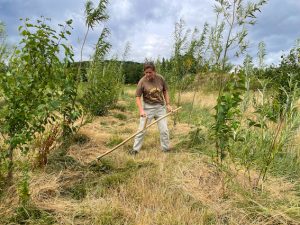
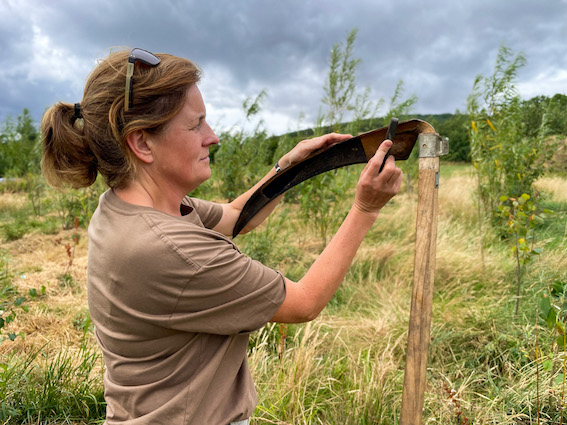
Gorse Farm is a three-acre organic certified market garden nestled in the foothills of Mount Leinster on the Carlow–Wexford border. Run by Janet Power and Jenny Watkins, the farm specialises in the production of salads and other annual crops, with areas dedicated to abundant hedgerows, trees, flowers, and re-wilding. More recently, Janet and Jenny have embraced the use of a scythe to manage an area of syntropic agroforestry on their farm. Composed of a mix of perennial fruit and nut trees and bushes planted in carefully spaced rows, the agroforestry system compliments the annual salad crops that are the mainstay of the farm. Here the scythe comes into its own as a tool used to cut long grass around the newly planted trees and bushes. In contrast to a heavy vibrating strimmer (which still has a role on the farm), the light Austrian scythe that Janet and Jenny use, allows for precise and targeted cutting of vegetation around the fruit trees. 

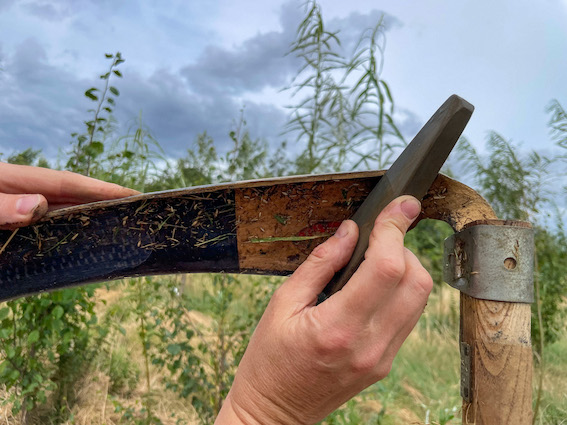
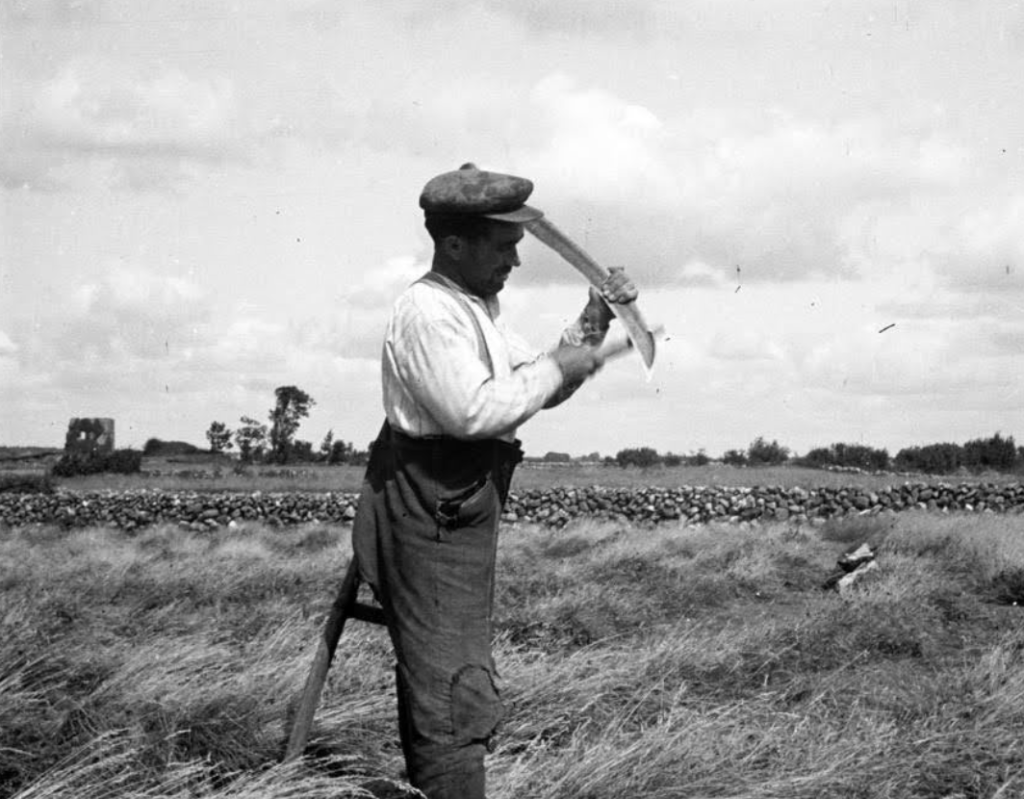
The scythe is a hand tool consisting of a narrow, curved blade attached to a long handle, called a snath or sned. Traditionally used to mow grass for hay-making, the scythe was probably introduced to Ireland by the Normans during the medieval period. By the turn of the nineteenth century, scythes began to be used in the grain harvest, a practice possibly partly introduced by labourers returning from seasonal work in Britain. Their primary use remained in cutting meadows for hay, with smaller reaping hooks and sickles used in the harvest. Scythes continued in use in Ireland into the mid-twentieth century, when they were largely replaced by fossil-fuel powered mowers, harvesters, and strimmers. Rich folklore surrounding scything survives in the National Folklore Collection, encompassing tales of heroic feats of work (men who mowed five or six aces in a single day), to local vocabularies: like ‘swarth’ or ‘driskawn’, terms for ‘the amount cut by a swish of the scythe’ in south Wexford (The Main Manuscript Collection, Vol. 0577, P. 305).

Growing up on a dairy farm, Janet remembers her father using a heavy Irish-style scythe, but it was more recently through the Song of the Scythe festival organised by the Acorn Project, Co. Kilkenny, that she and Jenny were reintroduced to the tool. Part of a general scything revival in Ireland and Britian from the turn of the millennium, Song of the Scythe and other events and groups have been implemental in popularising the use of the light Austrian scythe and the benefits of scything more generally. Not reliant on carbon-emitting fossil fuels, the scythe is also more wildlife friendly, and easier on the body than mechanical alternatives. It fosters a slow considered approach, as Janet says a sense of community, a ‘sense of bringing joy and the human hand and the human spirit into what you’re doing’. 

References

Bell, J. (1981) Sickles, Hooks, and Scythes in Ireland, Folk Life, Vol. 19, No. 1, 26–35. 

Gorse Farm: https://www.gorsefarm.ie/

Song of the Scythe Festival: https://theacornproject.ie/song-of-the-scythe-2026

The Scythe Association of Britain & Ireland: https://scytheassociation.org/

Sharpening a scythe, Wicklow 1939 by Domhnall Ó Cearbhaill “The Photographic Collection, B028.10.00004” by Dúchas © National Folklore Collection, UCD is licensed under CC

This project was funded by:

×